
Knowledge Hub
Application Notes, White Papers and Industry Articles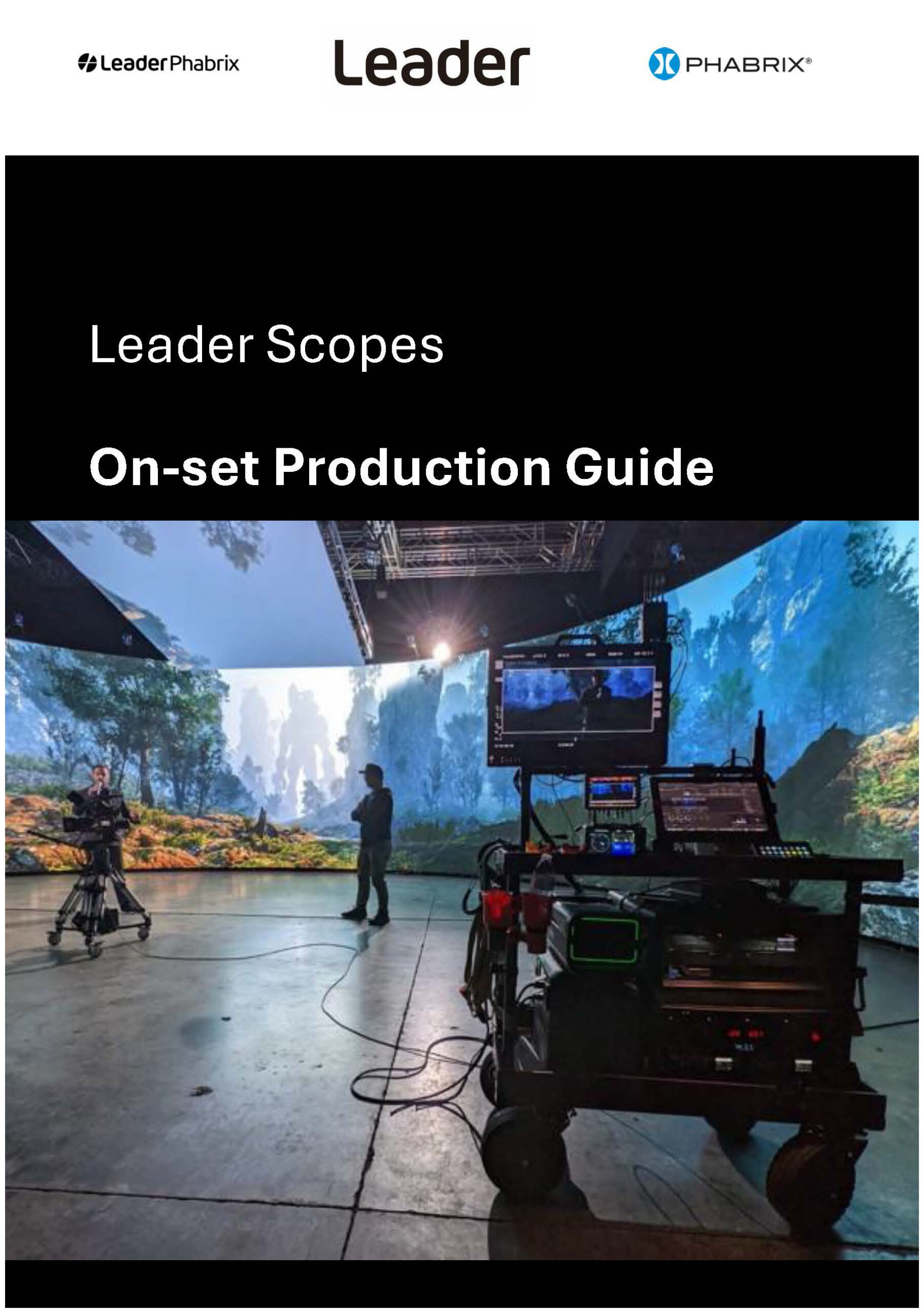
Application Guide
Leader Scopes | On-set Production Guide
Discover how modern productions are bridging the gap between cinematic quality and real-world budgets with the Leader On-Set Production Guide. As OTT content continues to evolve, on-set technical monitoring is becoming essential to ensure accuracy, efficiency, and creative consistency.
This Guide has been created to describe how Leader Test and Measurement products are deployed and utilized throughout the broadcaster workflows. This guide describes the various on-set workflows that broadcasters utilize and how Leader Test and Measurement products can simplify workflows and improve efficiencies whilst continuing to deliver the highest quality programming.
The continued rapid growth of high-end scripted programming for OTT streaming platforms such as Apple, Disney, Netflix and Amazon Prime Video has driven the adoption of feature film production techniques across television and streaming workflows. While these productions often have substantial budgets, they rarely match the financial scale of major theatrical releases. As a result, production teams must balance cinematic production values with strict cost control.
One effective approach to achieving this balance is robust on-set technical monitoring. By identifying and correcting technical or colour-related issues during capture, productions can avoid costly delays and remediation in post-production, reducing reliance on the traditional “fix it in post” model.
White Paper
PTP System Commissioning: A Series of Grandmaster Changeover tests for PTP system in IP media networks
Learn essential testing procedures to verify PTP system performance and ensure seamless timing redundancy in hybrid IP/SDI broadcast facilities.
Leader has created this guide to give you a comprehensive understanding of PTP Grandmaster changeover testing. In the guide, you’ll find out:
- How to perform six critical GM changeover tests, from graceful transitions to abrupt failures
- Why Boundary Clock switches are essential for stable PTP distribution in broadcast networks
- How the BMCA (Best Master Clock Algorithm) works to automatically select the best timing source
- How to prevent reference mismatches between BB/TLS and PTP in hybrid environments
- Configuration strategies to avoid unnecessary changeovers using “Enable Only Once” settings
- Best practices for maintaining phase alignment across both SDI and IP reference systems
With the widespread adoption of SMPTE ST 2110 and hybrid IP/SDI infrastructures, ensuring reliable and resilient PTP timing has become mission-critical. When a PTP Grandmaster fails or enters holdover, the system must seamlessly transition to a backup without disrupting production.
This guide provides broadcast engineers with structured commissioning tests that validate system behaviour during GM changeovers, verify timing stability across Boundary Clocks and Followers, and ensure that both PTP and traditional BB/TLS references remain phase-coherent, even during fault conditions.
By following these recommended tests with Leader LT4670 SPG and LT4448 ECO units, you can confidently deploy robust, GPS-independent timing architectures that guarantee uninterrupted synchronisation for live broadcast operations.
White Paper
NMOS: What is it and why do we need it?
Find out the basics of NMOS, why it’s useful, and how you can find, connect, and configure media devices within your audio and video networks.
Leader has created this guide to give you a greater understanding of NMOS. In the guide, you’ll find out:
- How to use NMOS to find senders and receivers on the network
- What simplistic and advanced NMOS block diagrams look like
- How to make an NMOS connection work to control devices
- The ins and outs of looking at the NMOS node server with your browser
- Useful NMOS terminology and interface specifications you can refer back to
With the widespread adoption of SMPTE ST 2110 and ST 2022-6 standards, it has been difficult to achieve useful interoperability in professional networked media environments without a way to specify the control or application planes.
To address this, the Advanced Media Workflow Association (AMWA) developed the Networked Media Open Specifications (NMOS) family of free and open specifications.
Now, rather than having to manually create and update host tables containing IP addresses and host names for complex broadcast systems, NMOS moves the industry toward a fully-networked architecture, where the specifications provide for the management of video, audio, and data streams through specifying how to discover, control, and connect to network elements, send tally information, control audio channels, and much more.

White Paper
How to ensure your Blackburst survives the Introduction of PTP
We have all grown up with Blackburst reference in our facilities and the only change we might have had to manage is the introduction of tri-level sync when facilities started migrating to HD.
The expansion of Blackburst tri-level sync reference systems was relatively simple. Either daisy chain the new device with the loop-through genlock output from an existing device or use a distribution amplifier to split the Blackburst /tri-level sync reference signal. What could be simpler?
Broadcasters are now faced with a new reference: Precision Time Protocol or PTP as we call it. Fortunately, this reference is already being used in other industries like finance, power utilities, telecommunications, and has standards associated with it.
Every industry sector claims to be unique, and the broadcast business is no exception. However, for PTP the broadcast industry is very much unique. The standards authorities have created a broadcast specific profile for PTP and understanding how that profile is applied to the broadcast industry will ensure that your existing SDI infrastructure can integrate with your new video over IP infrastructure without QoS issues being introduced.
In this paper we will discuss the new challenges broadcasters are facing and highlight some of the pitfall that can easily be avoided.