
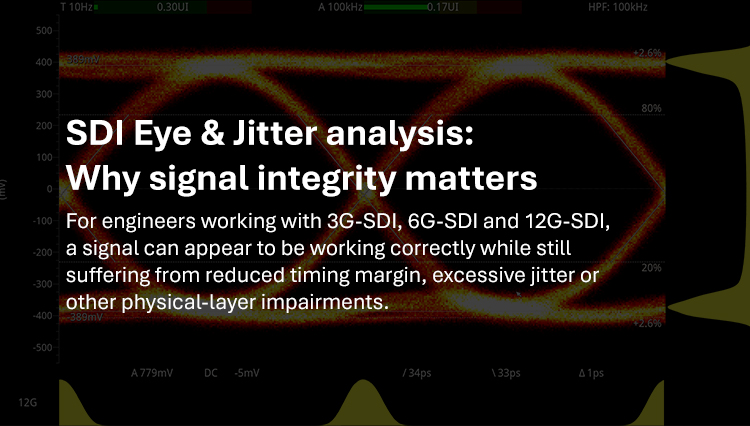
For engineers working with 3G-SDI, 6G-SDI and 12G-SDI, a signal can appear to be working correctly while still suffering from reduced timing margin, excessive jitter or other physical-layer impairments.
This is where SDI eye and jitter analysis becomes an essential part of the test and measurement toolkit.
The PHABRIX Qx Series provides advanced physical-layer analysis to help engineers understand what is happening at the SDI interface. For engineers who need this capability in the field, the new LeaderPhabrix Sx2 Series brings comprehensive 12G-SDI signal generation, analysis and monitoring into a compact handheld instrument.
What is an SDI eye diagram?
An eye diagram overlays many bits of a digital signal to create a visual representation of signal quality.
A healthy SDI eye has a clear, open appearance, providing sufficient vertical and horizontal eye opening. As impairments increase, the eye begins to close.
Eye analysis can reveal issues including:
- Excessive noise
- Signal attenuation
- Rise and fall-time problems
- Reflections and impedance mismatches
- Inter-symbol interference
- Excessive jitter
- Poor cabling or connectivity
Rather than simply asking “Is there a picture?”, eye analysis helps answer the more important question: “How healthy is the signal?”
Why does jitter matter?
Jitter is variation in the timing of a digital signal from where its transitions are expected to occur. Excessive jitter reduces timing margin at the receiver and, if severe enough, can lead to errors or instability.
Jitter can originate from transmitters and receivers, cabling, routers, distribution equipment, conversion equipment and clocking or synchronization issues.
At 12G-SDI data rates, these physical-layer considerations become increasingly important. Small variations in signal quality can have a much greater impact on available eye opening and timing margin.
Measuring jitter
Dedicated test and measurement equipment allows engineers to quantify signal performance and identify potential problems before they become operational failures.
The PHABRIX Qx Series provides detailed SDI physical-layer analysis, including eye and jitter measurements, making it suited to laboratory, manufacturing, integration and QC applications. The LeaderPhabrix Sx2 Series brings advanced 12G-SDI analysis into a portable format, making it ideal for commissioning, maintenance, field service and troubleshooting.
Engineers can test signals at different points in a chain:
Source → Cable → Patch Panel → Router → Distribution → Destination
Comparing measurements along the path can help identify where signal quality deteriorates and accelerate fault finding.
Confidence starts at the physical layer
For modern broadcast engineers, confidence in an SDI workflow requires more than knowing that the picture is present.
Eye and jitter analysis provides visibility into the underlying physical-layer performance, helping engineers identify problems earlier, improve system reliability, and maintain confidence in their infrastructure.
Whether you’re working with 3G, 6G or 12G-SDI, the PHABRIX Qx Series and LeaderPhabrix Sx2 Series provide complementary tools for understanding and validating SDI signal integrity.